
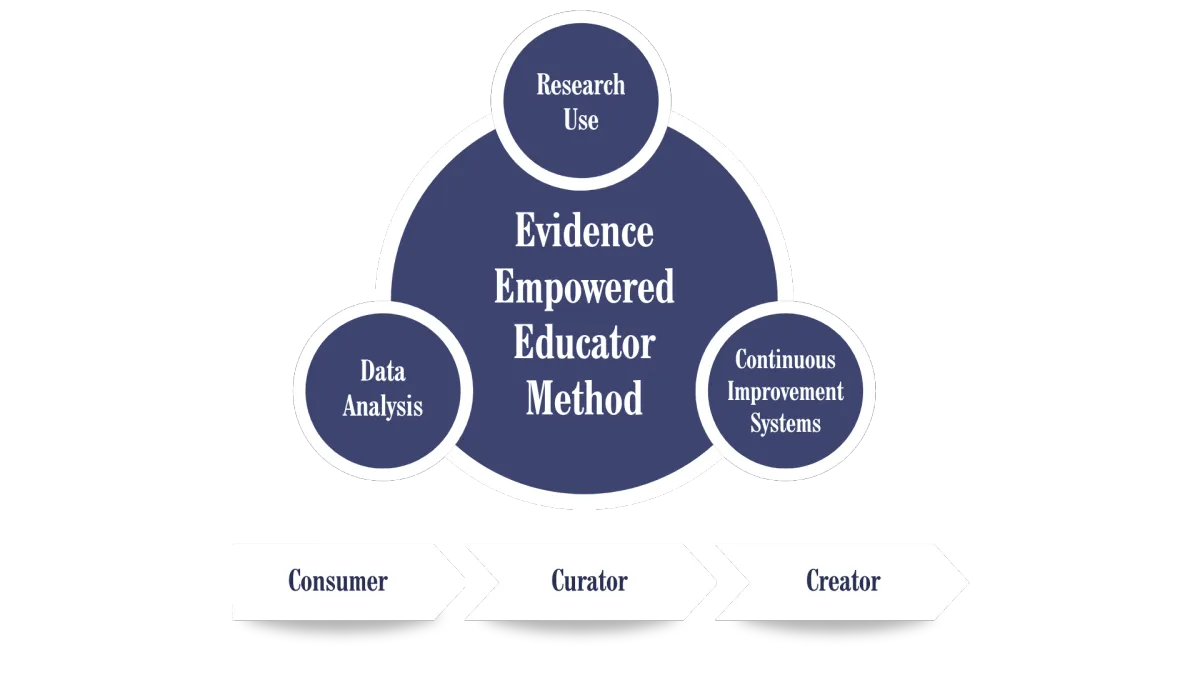
The Evidence Empowered Educator Method
Research Use
Using research with purpose to make better decisions and build stronger systems.
Using Evidence to Inform Decisions—Not Just Justify Them
Most educators believe in using research. In fact, if you ask a room full of school leaders whether research should inform decisions, nearly every hand will go up. The intention is there. The belief is there. And yet, when you look at how decisions are actually made in schools, research is often missing—or worse, misused.
It typically shows up too late.
A strategy has already been selected. A program has already been purchased. A plan has already been written. Only then does someone ask, “Can we find research to support this?” At that point, the role of research has shifted. It is no longer informing the decision. It is being used to justify it.
This is one of the most common breakdowns in school improvement efforts. And it is exactly the problem that the E3 Method is designed to solve.
What Is Research Use?
Within the E3 Method, research use is not defined by whether research is present. It is defined by how and when research is used in the decision-making process.
Research use is the disciplined practice of identifying relevant evidence, interpreting it accurately, and applying it thoughtfully to a specific context. It requires more than locating a single article or citing a familiar author. It involves engaging with a body of knowledge and asking what that body of knowledge suggests about a problem you are trying to solve.
This distinction matters. There is a significant difference between using research as a reference point and using research as a decision-making tool. The former is passive. The latter is active. The former supports what you already believe. The latter has the potential to change your thinking.
In the E3 framework, research use is not about replication. Schools are not laboratories, and educators are not expected to copy findings exactly as they appear in a study. Instead, research serves as a guide. It helps you understand what has been tried, what has been shown to work under certain conditions, and what factors influence success.
When used well, research does not give you answers. It gives you better questions.
Why Research Use Matters
In the absence of strong research use, decisions tend to rely on a familiar set of inputs: past experience, professional judgment, anecdotal evidence, and external pressures. These are not inherently problematic. In fact, they are an important part of educational decision-making. But when they operate without the support of research, they create blind spots.
For example, a strategy that worked well in one classroom may not scale across a school. A program that produced short-term gains may not sustain improvement over time. A widely shared idea may feel effective without ever being rigorously tested.
Research helps mitigate these risks. It allows educators to learn from a broader base of experience than their own. It surfaces patterns that are not visible at the local level. It challenges assumptions and introduces alternative approaches.
Perhaps most importantly, it increases the likelihood that the time, energy, and resources invested in improvement efforts will lead to meaningful results. In a field where capacity is limited and demands are high, that matters.
This is not about replacing professional expertise. It is about strengthening it. Research does not override the judgment of educators—it sharpens it.
The Timing Problem: When Research Shows Up Too Late
One of the most consistent issues in schools is not whether research is used, but when it is used.
When research enters the process after a decision has already been made, it cannot influence that decision. It can only validate it. This creates a subtle but important shift in how research is selected and interpreted. Instead of asking, “What does the research suggest we should do?” teams begin asking, “Can we find research that supports what we have already decided to do?”
This leads to cherry-picking. It leads to overreliance on single studies. It leads to confirmation bias. And over time, it erodes the integrity of the decision-making process.
In contrast, when research is introduced early—before a solution is selected—it plays a fundamentally different role. It helps define the range of possible approaches. It highlights what has been effective in similar contexts. It surfaces trade-offs and considerations that might otherwise be missed.
The difference is not subtle. It is structural.
If you want research to influence decisions, it has to be part of the process before those decisions are made.
Moving from Single Studies to Bodies of Evidence
Another common challenge in research use is the tendency to rely on individual studies rather than considering the broader body of evidence.
A single study can be compelling. It often tells a clear story. It may show strong results. It is easy to understand and easy to share. But it is also limited. Every study is conducted within a specific context, with specific participants, using specific methods. Its findings are informative, but they are not definitive.
Strong research use requires a shift in focus—from individual findings to patterns across studies.
When multiple studies point in a similar direction, confidence increases. When findings are mixed, it raises important questions about context, implementation, and variation. When evidence is limited, it signals the need for caution.
This is where the role of the educator becomes critical. Research does not interpret itself. It requires thoughtful engagement. It requires asking questions such as: Under what conditions did this work? How similar is that context to ours? What might need to be adapted?
This is not about becoming an academic researcher. It is about developing the ability to engage with research in a way that is practical, grounded, and informed.
What Research Use Looks Like in Practice
In schools where research use is strong, you can see it in how conversations unfold.
When a problem is identified, the immediate response is not to jump to solutions. Instead, there is a pause. Teams take time to understand the problem more clearly and to explore what research suggests about that type of challenge.
Multiple sources are considered. Findings are discussed, not just presented. There is space for interpretation, for questioning, and for connecting research to the local context.
Importantly, research is not treated as a final answer. It is treated as an input—one that informs the direction of the work but does not dictate it. Educators still make decisions. They still adapt strategies. But those decisions are grounded in a broader understanding of what is likely to work.
Over time, this changes the culture of the organization. Research becomes part of how decisions are made, not something that is added on after the fact.
Common Misconceptions About Research Use
One of the barriers to strong research use is the set of misconceptions that surround it.
Some educators believe that using research requires advanced statistical knowledge or access to academic databases. Others assume that research is too abstract or disconnected from the realities of the classroom. Still others see it as time-consuming and impractical.
These perceptions are understandable, but they are not entirely accurate.
Effective research use does not require deep expertise in methodology. It requires a clear process. It requires knowing where to look, how to interpret what you find, and how to connect it to your context.
It also does not require large amounts of time. In fact, a structured approach to research use can save time by preventing teams from pursuing ineffective strategies or revisiting the same problems repeatedly.
Perhaps the most important misconception is that research limits professional autonomy. In reality, it does the opposite. It expands the range of options available to educators and provides a stronger foundation for decision-making.
The E3 Shift: From Justification to Inquiry
At the heart of the E3 Method is a shift in how research is approached.
Instead of using research to justify decisions, E3 encourages educators to use research as part of an ongoing inquiry process.
This begins with a clearly defined problem. It continues with a search for relevant evidence. It involves interpreting that evidence in light of the local context. And it leads to decisions that are informed, but not constrained, by what the research suggests.
This shift has practical implications. It changes the questions that teams ask. It changes how meetings are structured. It changes how success is defined.
It also creates a feedback loop. As strategies are implemented, data is collected. That data is then analyzed, and the findings are used to refine the approach. In this way, research use is not a one-time activity. It is part of a continuous cycle.
Research Use and the Three Roles
Within the E3 framework, research use is not a single skill. It is expressed differently depending on how an educator engages with evidence.
As a consumer, the focus is on finding and applying research. This involves identifying relevant sources, interpreting findings, and making decisions based on that information.
As a curator, the focus shifts to organizing and sharing research. This might involve synthesizing multiple studies, translating findings into accessible language, or helping others understand how research applies to their work.
As a creator, the focus expands further. Educators begin to contribute to the evidence base by documenting their own work, conducting action research, or evaluating the impact of their strategies.
These roles are interconnected. Strong research use involves movement between them. Educators consume research to inform their decisions, curate research to support others, and create new knowledge through their practice.
Building a Stronger Research Use Process
Improving research use does not require a complete overhaul of existing systems. It begins with small, intentional shifts.
It starts with defining problems more clearly. Without a clear problem, research searches tend to be unfocused and unproductive.
It continues with expanding the range of sources considered. Looking beyond a single article or familiar author increases the likelihood of identifying useful patterns.
It involves creating space for discussion and interpretation. Research is more powerful when it is engaged with collaboratively.
And it requires a commitment to using research early in the process, not after decisions have been made.
These shifts may seem simple, but their impact is significant. Over time, they lead to more informed decisions, more effective strategies, and more sustainable improvement.
Putting Research Use Into Action
Understanding research is not the same as using it. The real work begins when research becomes part of the everyday decision-making process.
This is where many schools struggle. Not because they lack access to research, but because they lack a system for using it consistently.
The E3 Method provides that system. It connects research use with data analysis and continuous improvement, creating a structure that supports ongoing learning and adaptation.
For educators who want to move beyond understanding and into action, the next step is to engage with this work in a more structured way.
Inside the community, educators work together to identify problems, find and interpret research, apply it in real contexts, and refine their approach over time
Final Thought
Research is one of the most powerful tools available to educators. But its value is not in its presence. It is in its use.
When research is used early, thoughtfully, and consistently, it transforms how decisions are made. It strengthens professional judgment. It increases the likelihood of success.
And over time, it helps build something that every school is striving for: A system where improvement is not dependent on individual effort—but is built into the way the organization works.