
The Evidence Empowered Educator Method
Curator Role
Turning Evidence Into Something Others Can Actually Use
What Does It Mean to Be a Curator?
Within the E3 Method, a curator is someone who organizes, translates, and shares evidence so that it can be understood and used by others.
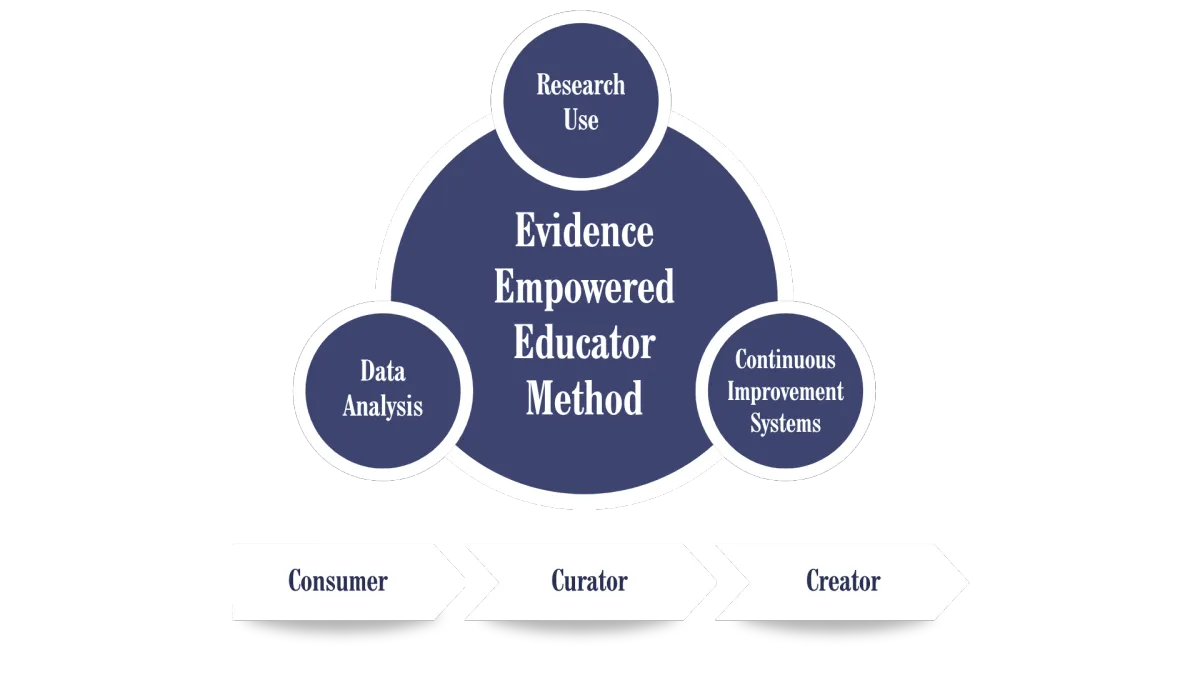
This role sits between consumption and creation. It takes what has been learned through research and data and makes it accessible, actionable, and relevant to a broader audience.
Curation is not simply sharing information. It is shaping it. It involves selecting what matters, clarifying meaning, and presenting it in a way that supports understanding and action.
A curator does not just pass along evidence. They make it usable.
Why the Curator Role Matters
In many organizations, the limiting factor is not access to information. It is the ability to move that information effectively across people and teams.
Without curation, evidence remains siloed. Individuals may develop strong understanding, but that understanding does not translate into collective practice. Teams may analyze data, but the insights do not extend beyond the meeting. Research may be identified, but it is not integrated into day-to-day work. The Curator role addresses this gap.
It ensures that evidence does not stop at awareness. It supports the transition from individual understanding to shared practice. It creates alignment by helping teams work from a common understanding of what the evidence suggests.
When this role is strong, knowledge flows. When it is weak, knowledge stalls.
The Problem with Passive Sharing
One of the most common misconceptions about curation is that it is simply a matter of sharing information. An article is emailed. A report is uploaded. A dataset is presented.
While these actions make information available, they do not make it usable. Passive sharing assumes that others will take the time to interpret the information, understand its relevance, and apply it to their work. In reality, this rarely happens. Educators are busy. Time is limited. Without support, even high-quality information often goes unused.
Effective curation requires more than distribution. It requires translation. This means clarifying what the evidence says, why it matters, and how it connects to the work at hand. It involves reducing complexity without losing meaning. It creates a bridge between information and action.
From Information to Shared Understanding
A key shift within the Curator role is moving from information sharing to building shared understanding.
Information can be distributed quickly. Shared understanding takes time and intention.
It requires selecting the most relevant evidence, organizing it in a coherent way, and presenting it with clarity. It involves anticipating questions, addressing misconceptions, and connecting the evidence to the specific context of the team or organization.
This process creates alignment. When teams operate from a shared understanding, decisions become more consistent. Strategies are implemented with greater coherence. Communication becomes more effective.
Without this alignment, even well-informed individuals may move in different directions.
What the Curator Role Looks Like in Practice
In practice, the Curator role is visible in how evidence is communicated and used within an organization.
A curator might take a set of research findings and summarize the key ideas in plain language, highlighting what is most relevant to the team’s current work. They might organize data into a format that makes patterns more visible and easier to discuss. They might facilitate conversations that help others interpret and apply evidence.
Importantly, curation is not about controlling information. It is about supporting access and understanding.
A strong curator does not position themselves as the sole source of knowledge. Instead, they create structures and resources that enable others to engage with evidence more effectively. Over time, this builds capacity within the organization. More individuals are able to understand and use evidence, reducing reliance on a single person or team.
Common Misconceptions About Curation
One misconception is that curation is a passive or secondary role. In reality, it is highly active and central to the success of evidence-based work.
Another misconception is that curation requires creating large, formal resources. While this can be part of the work, effective curation often happens through small, consistent actions. A well-structured summary, a clear visual, or a focused discussion can have a significant impact.
There is also a tendency to assume that if information is available, it will be used. This overlooks the importance of interpretation and context. Availability does not guarantee understanding.
Recognizing these misconceptions helps elevate the importance of the Curator role and clarifies what effective curation looks like.
The E3 Shift: From Sharing to Enabling
At the core of the Curator role is a shift from sharing information to enabling its use.
This shift changes the focus of the work. Instead of asking, “How do we distribute this?” the question becomes, “How do we make this usable?” It involves thinking about the audience, the context, and the intended outcome. It requires clarity about what matters most and how it should be communicated.
This approach increases the likelihood that evidence will actually influence practice. It moves the organization from awareness to action.
The Curator Role Across the E3 Pillars
The Curator role is expressed across all three pillars of the E3 Method.
In research use, it involves synthesizing findings and translating them into practical guidance. In data analysis, it includes organizing and presenting data in ways that highlight meaningful patterns. In continuous improvement systems, it involves documenting processes, sharing insights, and supporting collective learning.
These applications are interconnected. Strong curation helps integrate research, data, and systems into a cohesive approach.
The Curator role is what allows evidence to move through the system.
Building Strength as a Curator
Developing the Curator role begins with a shift in mindset. It involves recognizing that making information usable is as important as finding it.
It requires attention to clarity. This means reducing unnecessary complexity, focusing on key ideas, and communicating in a way that is accessible to others. It involves organization, ensuring that information is structured in a way that supports understanding. It also requires intentionality. Curation is most effective when it is aligned to a specific purpose. What do others need to know? What will help them act? What will support their understanding?
Over time, these practices become part of how information is handled within the organization. Evidence becomes easier to access, easier to understand, and more likely to be used.
Putting the Curator Role Into Action
Understanding the Curator role is an important step. The impact comes from applying it consistently within teams and organizations.
Many schools have individuals who naturally take on aspects of this role, but it is often informal and unsupported. The E3 Method provides a framework for making this work more intentional and more effective. By connecting curation with research use, data analysis, and continuous improvement systems, it creates a structure where evidence can move, be understood, and influence practice. For those ready to strengthen this role, the next step is to engage with others in a structured and collaborative way.
Inside the community, educators work together to organize and share evidence, translate insights into practice, and build systems that support collective understanding and improvement.
Final Thought
Evidence has little impact if it stays where it started. The value of research and data is not just in their use by individuals, but in their ability to shape collective practice. The Curator role makes that possible. It turns isolated understanding into shared knowledge. It turns information into action. And over time, it helps build a system where evidence does not just exist—it moves, it spreads, and it drives meaningful change.