
The Evidence Empowered Educator Method
Creator Role
Generating Evidence to Improve Practice for Everyone
What Does It Mean to Be a Creator?
Within the E3 Method, a creator is someone who generates new evidence through their own practice.
This does not mean conducting large-scale academic research. It does not require complex experimental designs or advanced statistical analysis. Instead, it involves systematically studying your own work in order to understand its impact and improve it over time.
Creation is about making your practice visible. It is about documenting what you are doing, collecting data on its effects, and using that information to refine your approach. In this sense, creation is not separate from practice. It is embedded within it.
Why the Creator Role Matters
Most improvement efforts rely heavily on existing knowledge. Educators look to research and data to inform their decisions, which is essential. But every school operates within a unique context. Students, staff, resources, and constraints vary. What works in one setting may not work in another without adaptation. The Creator role addresses this gap.
It allows educators to generate evidence that is directly relevant to their context. It provides a way to test strategies, understand their impact, and make informed adjustments. It turns implementation into a source of learning.
Without this role, improvement efforts often rely on assumptions. Strategies are implemented, but their effectiveness is not fully understood. Adjustments are made, but not always based on evidence.
With the Creator role, learning becomes intentional. Evidence is generated continuously, and that evidence drives improvement.
The Problem with Implementation Without Evidence
One of the most common patterns in schools is the implementation of strategies without a clear process for evaluating their impact.
A new approach is introduced. Teachers begin using it. Over time, impressions form. Some believe it is working. Others are less certain. Conversations take place, but they are often based on perception rather than data.
Eventually, a decision is made. The strategy is either continued, modified, or replaced.
This process can feel reasonable, but it is limited. Without systematic evidence, it is difficult to know what actually worked, what did not, and why.
The Creator role introduces structure to this process. It ensures that implementation is accompanied by intentional data collection and analysis. It turns experience into evidence.
From Doing the Work to Studying the Work
A key shift within the Creator role is moving from simply doing the work to studying the work. In many settings, the focus is on execution. Plans are developed, and the emphasis is on carrying them out. While this is important, it is only part of the process.
Studying the work adds another layer. It involves asking questions about what is happening during implementation. It requires collecting data that can provide answers to those questions. It includes analyzing that data and using the findings to inform next steps. This shift does not require a complete redesign of practice. It requires a change in how practice is approached.
Over time, this creates a culture where learning is built into the work itself.
What the Creator Role Looks Like in Practice
In practice, the Creator role is visible in how educators approach improvement efforts.
When a strategy is implemented, a creator does not rely solely on observation or intuition. They identify specific questions they want to answer. They determine what data will help answer those questions. They collect that data in a consistent and manageable way.
As the strategy is used, they monitor its impact. They look for patterns in the data. They consider how different groups of students are responding. They reflect on what might be influencing the results. Based on this analysis, they make adjustments. They test those adjustments and continue the cycle.
This process does not require perfection. It requires consistency. Over time, it leads to a deeper understanding of what works, for whom, and under what conditions.
Common Misconceptions About Creation
One of the most significant barriers to the Creator role is the belief that it requires formal research training.
While formal research methods can be valuable, they are not a prerequisite for generating meaningful evidence. Many of the most useful insights come from simple, well-structured approaches to data collection and analysis.
Another misconception is that creation is time-consuming and separate from daily work. In reality, it can be integrated into existing routines. Data can be collected during instruction. Reflection can occur during regular meetings. Analysis can be built into existing processes.
There is also a tendency to view creation as something reserved for specialists. The E3 Method challenges this idea. It positions educators as capable of generating valuable knowledge through their own practice.
Recognizing these misconceptions helps make the Creator role more accessible.
The E3 Shift: From Application to Contribution
At the heart of the Creator role is a shift from applying evidence to contributing to it.
This shift expands the role of the educator. Instead of relying solely on external sources of knowledge, educators become active participants in the creation of that knowledge. This does not replace the use of research or data. It builds on it. Research informs what strategies to try. Data helps identify problems and monitor progress. Creation adds a new dimension by generating context-specific evidence that can refine and extend existing knowledge.
Over time, this creates a more dynamic and responsive approach to improvement.
The Creator Role Across the E3 Pillars
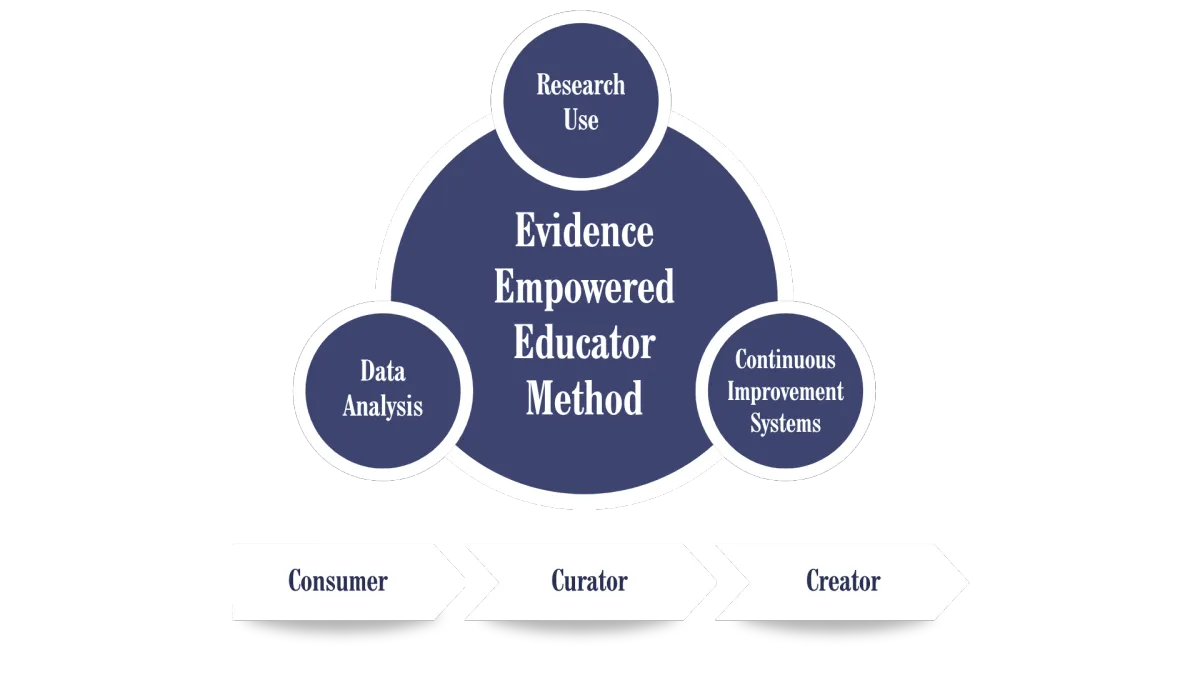
The Creator role is expressed across all three pillars of the E3 Method. In research use, it involves contributing to the body of knowledge through action research or systematic reflection. In data analysis, it includes designing data collection processes and generating new data to answer specific questions. In continuous improvement systems, it involves refining processes based on evidence and sharing what is learned.
These applications are interconnected. Strong creation practices help integrate research, data, and systems into a cohesive and evolving approach. The Creator role is what allows the system to grow and adapt over time.
Building Strength as a Creator
Developing the Creator role begins with a shift in perspective. It involves seeing everyday practice as a source of evidence.
It requires asking questions about your work and identifying what information would help answer those questions. It involves collecting data in a way that is manageable and aligned to your goals. It includes taking time to analyze that data and reflect on what it suggests. It also requires a willingness to iterate. Not every strategy will work as intended. The goal is not perfection. It is learning.
Over time, these practices become part of how work is approached. Improvement becomes more intentional, and decisions become more informed.
Putting the Creator Role Into Action
Understanding the Creator role is an important step. The impact comes from applying it consistently as part of your improvement efforts.
Many educators are already engaging in aspects of this work, but often without a clear structure. The E3 Method provides that structure, connecting creation with research use, data analysis, and continuous improvement systems.
This creates a system where evidence is not only used and shared, but generated and refined over time.
For those ready to take this next step, the opportunity is to engage with others in a structured and collaborative way.
Inside the community, educators work together to design and conduct action research, generate meaningful data, and use that evidence to improve practice in real time.
Final Thought
Using evidence is powerful. Sharing evidence is essential. But creating evidence is transformative. It turns practice into learning. It turns experience into knowledge. It turns educators into contributors to the field. And over time, it helps build a system where improvement is not dependent on external ideas alone—but is generated from within.