
The Evidence Empowered Educator Method
Consumer Role
Using Evidence to Make Better Decisions in Your Daily Work
What Does It Mean to Be a Consumer?
Within the E3 framework, a consumer is someone who engages with existing evidence in order to inform decisions.
This includes both research and data. It involves finding relevant information, interpreting it accurately, and applying it thoughtfully to your context. It is not about passively receiving information. It is about actively engaging with it.
Being a consumer does not require advanced expertise. It does not require conducting original research or building complex data systems. It requires a disciplined approach to using the information that is already available.
At its core, the Consumer role is about making better decisions by grounding them in evidence rather than assumption.
Why the Consumer Role Matters
The Consumer role is the foundation of the E3 Method. Before you can share evidence with others or generate new knowledge, you need to be able to engage with existing evidence effectively.
When this role is strong, decisions are more aligned to actual needs. Strategies are selected with greater intention. Time and resources are used more efficiently. When this role is weak, decisions tend to rely on habit, preference, or incomplete information. Teams may move quickly, but not always in the right direction.
Strengthening the Consumer role does not slow down decision-making. It improves the quality of those decisions.
In a field where every decision has an impact on students, that matters.
The Problem with Informal Evidence Use
One of the challenges in education is that evidence use is often informal. It happens in conversations, in meetings, and in moments of reflection. While this flexibility can be valuable, it can also lead to inconsistency.
Different individuals may interpret the same data in different ways. Research may be used selectively or misunderstood. Decisions may be influenced more by confidence than by evidence. Over time, this creates variability in practice. Some decisions are well-informed, while others are not. Some strategies are aligned to the problem, while others are not.
The Consumer role addresses this by introducing a more consistent approach. It does not eliminate professional judgment. It strengthens it by ensuring that it is informed by evidence.
From Reaction to Intention
A key shift within the Consumer role is moving from reactive decision-making to intentional decision-making.
In reactive environments, decisions are often made quickly in response to immediate needs. Data is reviewed, a pattern is identified, and a solution is selected. While this approach can feel efficient, it often leads to shallow analysis and misaligned strategies.
In contrast, intentional decision-making involves a pause. It begins with a clear definition of the problem. It includes a search for relevant evidence. It involves interpreting that evidence carefully before selecting a course of action.
This does not require a significant increase in time. It requires a change in process. Over time, this shift leads to decisions that are more precise, more effective, and more sustainable.
What the Consumer Role Looks Like in Practice
In practice, the Consumer role is visible in how educators engage with information.
When faced with a problem, a consumer does not immediately jump to solutions. They begin by asking questions. What is actually happening? What does the data show? What does research suggest about this type of challenge?
They seek out multiple sources of information. They consider patterns rather than isolated findings. They reflect on how that evidence applies to their specific context.
When interpreting data, they look beyond surface-level metrics. They examine variation, consider different groups of students, and explore changes over time. They treat data as something to understand, not just something to report.
When engaging with research, they move beyond single studies. They look for consistency across sources. They consider how findings might need to be adapted. This approach does not eliminate uncertainty. But it reduces it. It creates a stronger foundation for decision-making.
Common Misconceptions About Being a Consumer
There are several misconceptions that can make the Consumer role feel more complex than it actually is.
One is the belief that you need to be an expert in research or statistics to use evidence effectively. While deeper knowledge can be helpful, it is not required. What matters more is having a clear and consistent process for engaging with information.
Another misconception is that evidence use is time-consuming. In reality, a structured approach often saves time by reducing trial and error. It helps avoid pursuing strategies that are unlikely to work.
There is also a perception that using evidence limits creativity or professional autonomy. In practice, it does the opposite. It expands the range of options available and provides a stronger basis for choosing between them.
Understanding these misconceptions is an important step in developing confidence in the Consumer role.
The E3 Shift: From Information to Insight
At the heart of the Consumer role is a shift in how information is used. Instead of collecting information, the focus is on generating insight.
Information becomes valuable when it is interpreted in a way that informs action. This requires moving beyond simply reviewing data or reading research. It requires asking what that information means and how it should influence decisions.
This shift changes the nature of the work. It turns data review into analysis. It turns reading into interpretation. It turns decision-making into a more intentional process. Over time, this leads to stronger alignment between problems, strategies, and outcomes.
The Consumer Role Across the E3 Pillars
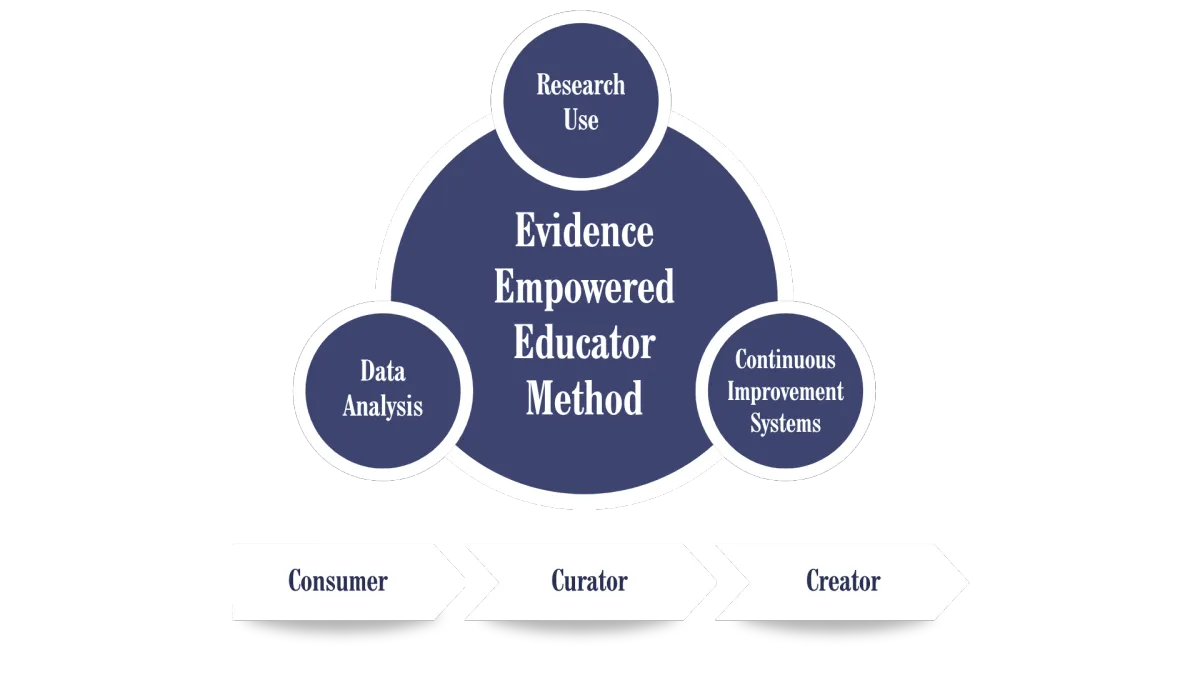
The Consumer role is expressed differently across the three pillars of the E3 Method.
In research use, being a consumer involves finding and interpreting relevant studies to inform decisions. In data analysis, it involves examining data to understand patterns and identify areas of need. In continuous improvement systems, it involves engaging with processes that guide implementation and learning.
These applications are interconnected. Strong evidence use requires the ability to move between them, using research, data, and systems as part of a cohesive approach.
The Consumer role is where this integration begins.
Building Strength as a Consumer
Developing the Consumer role does not require a complete shift in practice. It begins with small, intentional changes.
It starts with defining problems more clearly before seeking solutions. It involves looking at multiple sources of evidence rather than relying on a single perspective. It requires taking time to interpret information rather than reacting to it immediately.
It also involves asking better questions. What does this data actually show? What might explain this pattern? What does research suggest about this type of problem? How does this apply to our context?
Over time, these practices become habits. Decision-making becomes more consistent. Evidence use becomes more intentional.
Putting the Consumer Role Into Action
Understanding the Consumer role is an important first step. The real impact comes from applying it consistently in your daily work.
This is where many educators need support. Not because they lack access to evidence, but because they lack a system for using it effectively. The E3 Method provides that system. It connects the Consumer role with the broader framework of research use, data analysis, and continuous improvement, creating a structure that supports ongoing learning and improvement.
For those ready to strengthen their practice, the next step is to engage with this work in a more structured and collaborative way.
Inside the community, educators work together to apply evidence to real problems, interpret data collaboratively, and build systems that support consistent improvement.
Final Thought
Every educator is already a consumer of evidence. The difference is not whether you use evidence. It is how you use it. When the Consumer role is strong, decisions are more intentional. Strategies are more aligned. Outcomes are more meaningful. And over time, this creates a foundation for deeper work—where evidence is not just used, but shared, refined, and created.