
The Evidence Empowered Educator Method
Continuous Improvement Systems
Turning Good Ideas Into Better Results - Consistently Over Time
What Is a Continuous Improvement System?
Within the E3 Method, a continuous improvement system is not a document or a plan. It is a structured way of working that connects decisions, actions, and outcomes over time.
It is the process that ensures ideas are not only implemented, but tested, monitored, and refined.
A continuous improvement system creates a loop. A problem is identified, a strategy is selected, action is taken, data is collected, and the results are analyzed. Based on what is learned, the strategy is adjusted and the cycle continues.
This is what turns isolated efforts into sustained improvement.
Without a system, even strong ideas struggle to gain traction. With a system, even small actions can lead to meaningful change over time.
Why Systems Matter
In many schools, improvement efforts are driven by urgency. There is a problem that needs to be addressed, and the focus quickly shifts to finding a solution. Once a strategy is selected, the expectation is that implementation will lead directly to results.
When results do not materialize, the response is often to try something new. This creates a pattern of initiative fatigue. Teams move from one idea to the next without fully understanding what worked, what did not, and why. A continuous improvement system interrupts this pattern.
It slows the process down just enough to allow for learning. It creates structure around implementation so that strategies are applied consistently. It ensures that data is collected and analyzed in a way that informs next steps.
Most importantly, it builds continuity. Instead of starting over, teams build on what they have learned.
This is what allows improvement to accumulate over time.
The Problem with One-Time Plans
One of the most common misconceptions in education is that improvement can be achieved through a well-designed plan. Plans are important. They provide direction, establish priorities, and outline actions. But on their own, they are not sufficient.
A plan describes what you intend to do. A system determines whether it actually happens—and whether it works.
When schools rely on plans without systems, implementation becomes inconsistent. Actions are taken, but they are not monitored. Progress is assumed, but not verified. Adjustments are made, but not informed by data.
Over time, this leads to frustration. Teams feel like they are doing the work, but not seeing the results.
The issue is not the plan itself. It is the lack of a system to support it.
From Implementation to Learning
A key shift within the E3 Method is moving from a focus on implementation to a focus on learning. In many settings, success is defined by whether a strategy was implemented as intended. While fidelity of implementation is important, it is not the end goal. The goal is improvement.
A continuous improvement system reframes implementation as part of a larger learning process. Strategies are not simply carried out. They are tested. Data is collected to understand their impact. Results are analyzed to determine what is working and what is not. Based on that analysis, adjustments are made.
This creates a cycle where each iteration leads to a deeper understanding of the problem and a more effective response. Over time, this approach produces results that are more reliable and more sustainable than one-time implementation efforts.
What Continuous Improvement Looks Like in Practice
In schools with strong continuous improvement systems, the work looks different. Teams do not jump from idea to idea. They stay focused on clearly defined problems. They select strategies intentionally, often informed by research and data. They implement those strategies in a structured way, with attention to consistency.
As implementation unfolds, data is collected regularly. Not just at the end of a term or year, but throughout the process. This allows teams to see what is happening in real time.Meetings are centered on learning. Teams review data, discuss what they are observing, and consider what adjustments are needed. There is an expectation that strategies will evolve based on evidence.
This creates a culture where change is not reactive, but responsive. It is guided by what is learned, not by what is assumed.
The Role of Feedback Loops
At the heart of every continuous improvement system is a feedback loop. A feedback loop connects action to outcome. It ensures that the results of a strategy are captured, analyzed, and used to inform the next step. Without this loop, actions exist in isolation. With it, actions become part of a connected process.
Feedback loops require intentional design. Data must be collected at the right intervals. Measures must be aligned to the problem being addressed. Time must be allocated for analysis and discussion. When these elements are in place, feedback loops create momentum. They allow teams to make small, informed adjustments that compound over time.
This is what turns effort into progress.
Common Misconceptions About Continuous Improvement
One of the most common misconceptions is that continuous improvement requires large-scale change. In reality, it often begins with small, focused efforts.
Another misconception is that it is time-consuming. While it does require structure, a well-designed system often saves time by reducing inefficiencies and preventing repeated mistakes.There is also a tendency to view continuous improvement as an additional layer of work. In practice, it replaces less effective approaches. It provides a more efficient way of organizing and executing the work that is already being done.
Perhaps the most important misconception is that improvement is a linear process. Continuous improvement is not about moving from point A to point B in a straight line. It is about iterating, learning, and refining over time.
The E3 Shift: From Initiatives to Systems
At the core of the E3 Method is a shift from focusing on individual initiatives to building systems that support ongoing improvement. Initiatives come and go. Systems remain.
When a system is in place, new strategies can be integrated into an existing structure. They are not added as separate efforts. They become part of a continuous process of testing, learning, and refining.
This shift changes how schools approach change. Instead of asking, “What should we do next?” the question becomes, “How do we improve what we are already doing?”
This creates stability without stagnation. It allows for innovation while maintaining coherence.
Continuous Improvement and the Three Roles
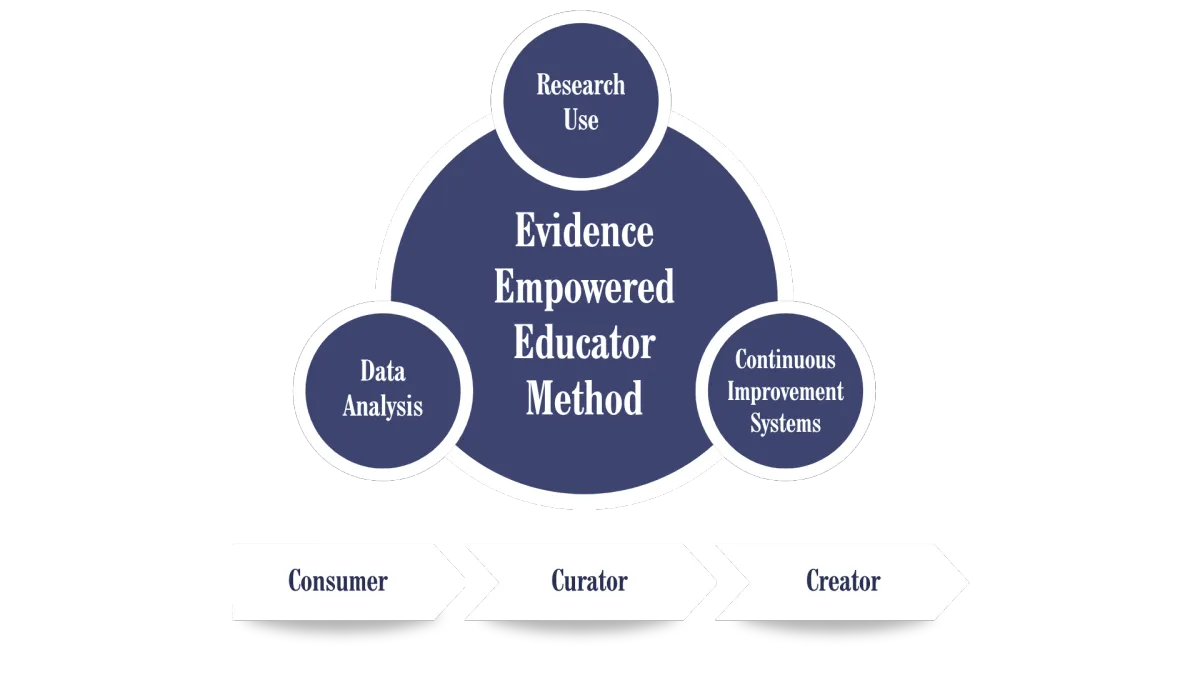
Within the E3 framework, continuous improvement systems are shaped by the roles of consumer, curator, and creator.
As a consumer, the focus is on engaging with existing improvement processes and applying them effectively. As a curator, the focus shifts to organizing and supporting the system, ensuring that processes are clear and accessible to others. As a creator, the role expands to designing and refining the system itself, developing new approaches based on experience and evidence.
These roles are interconnected. Strong systems depend on individuals and teams moving between them, contributing to the ongoing development of the process.
Building a Continuous Improvement System
Developing a continuous improvement system does not require starting from scratch. It begins with creating structure around work that is already happening.
It starts with clearly defining problems and aligning strategies to those problems. It involves establishing routines for implementation, data collection, and analysis. It requires creating space for reflection and adjustment. Over time, these elements come together to form a system. A way of working that supports consistent, evidence-informed improvement.
The key is not complexity. It is consistency.
Putting Continuous Improvement Into Action
Understanding the concept of continuous improvement is only the beginning. The real impact comes from putting a system into practice.
Many schools have the pieces in place—data, research, and motivated teams—but lack the structure to connect them. The E3 Method provides that structure, integrating continuous improvement systems with research use and data analysis to create a cohesive approach.
For educators who want to move from isolated efforts to sustained improvement, the next step is to engage with this work in a more structured way.
Inside the community, educators work together to design and implement continuous improvement systems, test strategies in real contexts, and refine their approach based on evidence.
Final Thought
Improvement does not happen because of a single plan or a single initiative. It happens because of a system.
A system that connects ideas to action, action to data, and data to learning. When that system is in place, improvement is no longer something you chase. It becomes something your organization produces—consistently, intentionally, and over time.